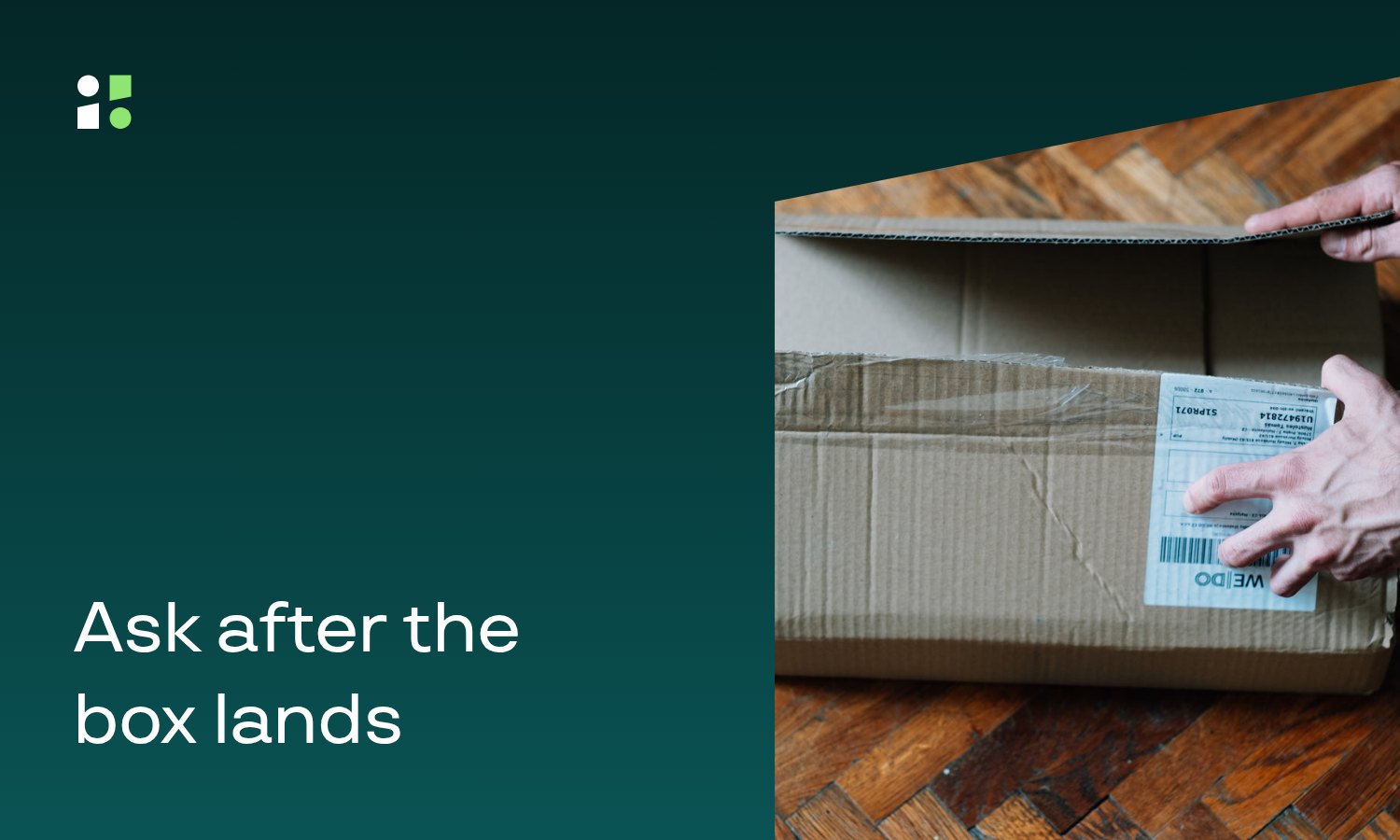
Ask a subscriber for feedback right after a box arrives and the relationship tends to get better. Ask before the box ships, or in the moment they skip an order, and the same question is followed by fewer future orders. The message barely changes. The timing does, and the timing is what the evidence separates.
Most subscription programmes treat feedback as a volume problem: more surveys, more touchpoints, more chances to learn something. There is decent evidence that this is the wrong axis, and that a programme sending fewer, better-timed asks does better than one sending more.
What is participation timing?
Participation timing is the point in a subscriber's delivery cycle at which a brand asks them to do something optional: rate a box, preview the next one, explain a skip, or fill in a preference. It is a scheduling choice, not a copy choice.
The distinction matters because most teams treat these asks as interchangeable. They are sent from the same tool, written in the same voice, and measured by the same response rate. The research below suggests they are not the same intervention at all.
What does the research actually say?
The clearest evidence comes from a study published in the Journal of Marketing in 2023 by Nita Umashankar, Kihyun Hannah Kim and Thomas Reutterer, which followed roughly 30,000 apparel subscription-box customers over several years and modelled the effect of individual participation touchpoints.
Two findings sit at opposite ends of the same delivery cycle.
Collecting feedback right after a delivered box was associated with about 5.7% higher customer lifetime revenue. That is the modelled average effect across the panel.
Prompting subscribers to preview an upcoming box, or to explain why they skipped a delivery, was followed by lower future opt-ins and lower spending. Same customers, same brand, same willingness to engage. Different moment.
The authors' proposed mechanism is worth sitting with, because it explains why a well-intentioned retention tactic can work in reverse. Asking someone to justify a skip makes them articulate a hesitation they had not yet put into words. Once it is stated, it is available to them again next month.
Two caveats before anyone rewrites a flow on the strength of this. It is one apparel curation company and a modelled panel rather than a controlled experiment, so the direction is better supported than the exact number. And it is about prompts the brand sends, not about the skip control itself, which is a different surface with its own evidence.
Why does the pre-delivery ask backfire?
The pre-delivery ask asks a customer to evaluate something that has not happened yet. There is nothing to evaluate except their own commitment, so the question quietly becomes "are you still sure about this?"
The skip prompt is the sharper version. A subscriber skipping an order is usually solving a small logistics problem: too much product in the cupboard, a holiday, a tight month. Left alone it stays small. Asked to explain it, they have to promote a logistics problem into a reason, and reasons generalise in a way that a full cupboard does not.
It is also a moment a large share of subscribers pass through, which is why the tactic is tempting. Recharge's 2023 State of Subscription Commerce, covering more than 15,000 merchants on its platform, reports that around a third of subscribers used a portal option such as skip or a frequency change, with skipping the most common choice. A skip survey is therefore not a marginal touchpoint. It reaches a meaningful slice of the subscriber base.
Which asks should move, and where?
Six changes, ordered by how little work they take.
1. Move the feedback email to delivery confirmation
If one ask changes position this quarter, make it this one. Fire the feedback request off the delivery event rather than a fixed day of the billing cycle, so it lands while the product is on the counter rather than in transit.
2. Delete the skip survey
Not shorten it, not make it optional. A skip is already a retention success compared with a cancellation, and in this panel it was the follow-up question, not the skip, that was followed by fewer future orders. Let the skip complete silently and say nothing.
3. Stop the pre-shipment preview nudge
The "your next box is coming, want to see what's in it?" email reads as a service and behaves like a decision prompt. If subscribers need to change an upcoming order, check that rescheduling and interval changes are switched on in your portal permissions, then let them make the change there rather than inviting them to reconsider the whole arrangement.
4. Separate operational mail from opinion mail
Shipping notifications, payment receipts and renewal reminders are operational and should keep firing on their own schedule. The rule here applies only to messages that ask the subscriber to form and express a view.
5. Move the review request behind the same rule
A review request is a feedback ask wearing a marketing hat. Anything that fires on order creation rather than order delivery is asking a customer to praise a box they have not opened.
6. Keep the self-service controls wide open
The finding is about prompts, not about flexibility. Removing the skip button because skips correlate with churn would be the exact wrong lesson from this research, which studied the message that follows the skip rather than the skip itself.
How do you measure whether the change worked?
Feedback timing is unusually easy to get wrong in reporting, because the obvious metric moves in the wrong direction on purpose.
Response volume will fall. You have removed asks, so fewer people will answer. That is the intervention working, not failing, and any dashboard that treats survey responses as the goal will read the change as a regression.
Watch three things instead, over at least two full billing cycles:
- Opt-in rate on the next order for subscribers who skipped, compared with the same cohort before the change. This is the number that differed in the research.
- Revenue per active subscriber across a fixed cohort, rather than blended across new and existing subscribers, where a growth month can hide the effect entirely.
- Feedback quality, read rather than counted. Fewer responses collected at a better moment tend to be more specific, and specific feedback is the kind that changes a product decision.
Give it two cycles before judging. A monthly programme that changes its email timing in week one is looking at a partial cohort by week four.
How do you set this up in Subi?
Three settings carry most of this.
Notification timing. Subi's customer and merchant email notifications live under Settings then Notifications, where each one can be enabled or disabled. Editing the template content itself needs email customization, which the pricing page lists from the Starter plan upward. That is where a feedback or review ask tied to the wrong event gets unhooked.
Portal permissions. The Subi customer portal lets subscribers view their subscription details, cancel, pause or resume, and skip an order without any setup. Rescheduling and delivery-interval changes ship switched off, and turning them on is part of customer permission control, which the pricing page lists on the Subi and Subi Plus plans. A merchant acting on this research widens self-service and narrows messaging rather than the other way round.
Skip limits. Subi lets a merchant cap how many times a customer can skip, under the same customer permission control on the Subi and Subi Plus plans. It is a real safeguard against a subscription that never bills, and it is also the setting most likely to be tightened for the wrong reason after reading a study like this one. Change it because of your own margin arithmetic, not because skips look like disengagement.
Frequently asked questions
Does this mean we should stop surveying subscribers entirely? No. The research separates asks by moment, not by whether they exist. Post-delivery feedback was the half that was associated with higher lifetime revenue.
Does it apply to cancellation surveys? It does not. A cancellation flow is a different surface with its own evidence, and the study covered prompts around skips and previews rather than the exit itself.
Does it apply to replenishment products, or only curated boxes? The panel was an apparel curation box. Transfer to replenishment consumables is plausible and untested, so treat it as a well-supported hypothesis for a coffee or supplement programme rather than a settled result.
Will removing the skip survey mean we learn nothing about skips? You still have the behaviour. Skip frequency, the products involved and what happens on the following order are all observable without asking, and they are less biased than a one-line reason typed under mild pressure.
Is 5.7% a number we can expect? Treat it as a direction rather than a forecast. It is a modelled average from one firm's panel, and the study design supports the sign of the effect more strongly than its size.
The short version
The subscription playbook has spent a decade telling merchants to engage more. This is one of the few findings that points at where engagement runs negative, and it is oddly specific: the moment a subscriber steps back is the moment to leave them alone.
Let skips be quiet. Ask when the box is open.